Mid century modern design has surged back into American homes, and nowhere is it more striking than in the kitchen. These cabinets, with their clean lines, warm wood tones, and minimalist hardware, bridge the gap between vintage charm and contemporary function. Whether restoring an original 1950s ranch or adding retro flair to a modern build, mid century kitchen cabinets deliver both visual impact and lasting value. This guide walks through what defines the style, how to select the right cabinets, and how to keep them looking sharp for decades.
Table of Contents
ToggleKey Takeaways
- Mid century kitchen cabinets feature flat-panel doors, minimalist hardware, and tapered legs that create an open, airy aesthetic bridging vintage charm with modern function.
- Authentic wood types like walnut, teak, oak, and birch define the period, while today’s reproductions use maple or alder stained to match, offering budget-friendly alternatives to solid wood cabinets.
- When selecting mid century kitchen cabinets, consider your space’s size and layout—lighter woods work best for small kitchens, two-tone schemes suit open-plan designs, and horizontal grain emphasizes length in galley layouts.
- Modern reproductions solve practical problems with consistent sizing, soft-close hinges, and warranties, while authentic vintage cabinets offer solid construction and unique character at the cost of potential wear and sizing inconsistencies.
- Pair your mid century cabinets with period-appropriate elements like subway tile backsplashes, brass or wood hardware, pendant lighting, and clean countertops to maintain design authenticity without clutter.
- Maintain wood and veneer cabinets by wiping spills immediately, using wood conditioner every few months, and addressing wear with light sanding and oil reapplication to preserve their beauty for decades.
What Defines Mid Century Modern Kitchen Cabinets?
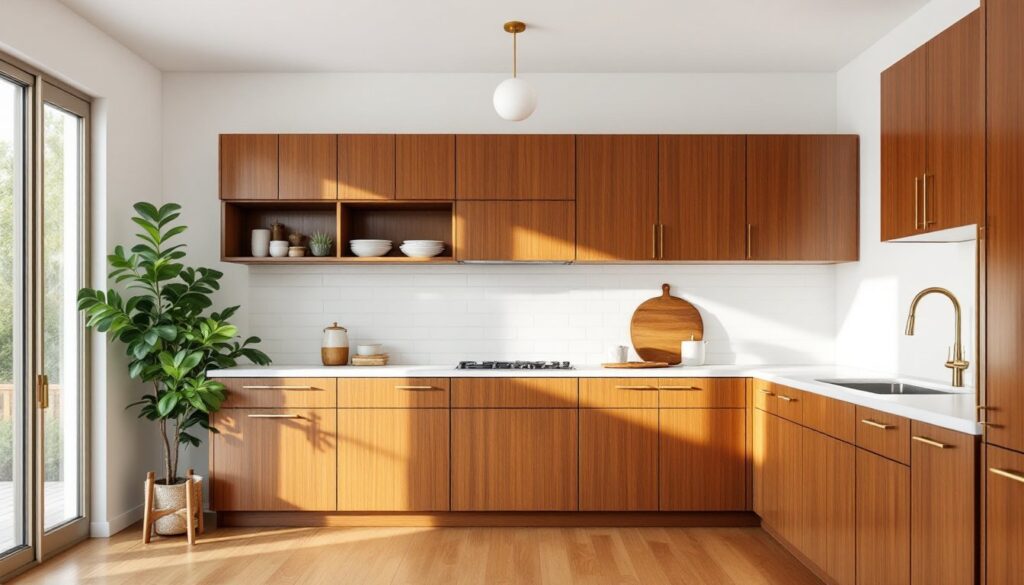
Mid century modern (MCM) refers to design trends from roughly 1945 to 1970, characterized by simplicity, functionality, and a connection to natural materials. In kitchen cabinetry, this translates to flat-panel doors (also called slab doors), minimal ornamentation, and horizontal emphasis.
Unlike traditional raised-panel or shaker-style cabinets, MCM designs skip the fuss. Door fronts are smooth, often frameless or European-style construction with concealed hinges. Hardware is either absent or pared down, think simple bar pulls, round knobs, or integrated finger grooves.
The era embraced open shelving and floating cabinets, creating visual lightness. Upper cabinets often stopped short of the ceiling, and lower cabinets sat on angled or tapered legs rather than toe kicks. This “leggy” look defines the period and keeps spaces from feeling heavy.
Color palettes leaned warm: natural wood grains dominated, but bold accent colors, avocado green, mustard yellow, or burnt orange, appeared on select doors or backsplashes. The style celebrated wood as a feature, not something to hide under layers of paint.
Key Design Features and Characteristics
Several hallmark features distinguish mid century cabinets from other styles:
- Flat-panel (slab) doors: No raised details, beading, or decorative molding. The door is a single, flat surface.
- Horizontal grain orientation: Wood veneer or solid panels often run horizontally to emphasize width and low-slung profiles.
- Frameless or face-frame construction: European-style frameless boxes became popular during this era, offering more interior space and a seamless exterior.
- Minimalist hardware: Sleek pulls in brass, chrome, or wood. Many cabinets used recessed pulls or edge pulls instead of protruding knobs.
- Tapered or angled legs: Lower cabinets on visible legs (often splayed outward) rather than a full toe kick. Legs are typically 4-6 inches tall.
- Two-tone finishes: Mixing natural wood uppers with painted lowers, or alternating cabinet door colors for visual rhythm.
- Open or glass-front uppers: Displaying dishware was part of the aesthetic. Sliding glass doors or open shelving reduced visual bulk.
These elements work together to create kitchens that feel open, airy, and uncluttered, key tenets of mid century philosophy.
Popular Wood Types and Finishes
Authentic mid century cabinets favored walnut, teak, oak, and birch. Each brought its own character:
- Walnut: Rich, dark brown with dramatic grain. The premium choice for high-end MCM cabinets.
- Teak: Golden-brown with natural oils that resist moisture. Common in Scandinavian-inspired designs.
- Oak: Light to medium tone with prominent grain. Often stained in honey or amber tones.
- Birch: Pale, fine-grained, and budget-friendly. Frequently used as a substrate with veneer overlays.
Finishes were typically oil-based or lacquer, leaving wood grain visible. Matte and satin sheens were standard, high-gloss finishes came later in the ’70s. Some cabinets used laminate (Formica, Arborite) in solid colors or wood-grain patterns, especially on lower-cost lines.
Today’s reproductions often use maple or alder as cost-effective alternatives, stained to mimic walnut or teak. Veneer over plywood remains common and authentic to the era’s construction methods.
How to Choose the Right Mid Century Cabinets for Your Space
Selecting mid century cabinets depends on the kitchen’s size, layout, and whether the home has period bones or modern construction.
For small kitchens (under 100 sq ft): Stick with lighter woods like birch or oak and consider floating upper cabinets. The leggy lower cabinets create visual space, but be realistic, exposed legs mean less toe room. If that’s a deal-breaker, look for a shallow toe kick (3-4 inches) in a recessed, dark finish.
For open-plan kitchens: Two-tone schemes work well here. Natural wood uppers paired with painted lowers (white, grey, or period colors like olive or coral) define the kitchen zone without closing it off.
For galley or L-shaped layouts: Horizontal grain and long, uninterrupted runs of slab doors emphasize length. Avoid upper cabinets on one wall to prevent a tunnel effect, open shelving or a single row of floating cabinets keeps sightlines clear.
Measure carefully. Standard MCM upper cabinets are 12-15 inches deep (modern uppers are often 12-13 inches), and lowers are the usual 24 inches deep. Cabinet leg height (4-6 inches) affects counter height: if using vintage bases, check that countertops will land at a comfortable 36 inches from the floor.
Consider mixing custom and stock. Stock slab-door cabinets from brands like IKEA’s VOXTORP line or Semihandmade overlays on IKEA frames offer budget-friendly MCM looks. Custom shops can replicate period details, tapered legs, edge pulls, walnut veneer, if accuracy matters.
Always confirm cabinet box construction. Plywood boxes hold up better than particleboard, especially around sinks. If buying vintage, inspect for water damage, delamination, and drawer slide wear.
Authentic Vintage vs. Modern Reproductions
Vintage purists hunt salvage yards, estate sales, and mid century dealers for original cabinets. The appeal is real: solid wood construction, unique hardware, and the patina of age. But there are trade-offs.
Pros of authentic vintage:
- True period materials (walnut veneer, teak, original Formica patterns).
- Solid construction, many were built better than today’s stock cabinets.
- Character and uniqueness: no two kitchens will match.
Cons of authentic vintage:
- Sizing inconsistencies. Standard dimensions have shifted: retrofitting old cabinets into new layouts can require custom filler strips.
- Wear and tear. Hinges sag, veneer chips, drawer boxes crack. Budget for restoration.
- Limited quantity. Finding a full set in good condition is tough. Mixing eras or styles may be necessary.
- No warranty or support.
Modern reproductions solve practical problems. Manufacturers now offer slab-door lines in MCM-friendly finishes, and several specialize in mid century styles.
Pros of reproductions:
- Consistent sizing compatible with modern appliances and plumbing.
- New hardware, soft-close hinges, and updated drawer slides.
- Warranties and easier sourcing.
- Can specify features like pull-out shelves or integrated lighting.
Cons of reproductions:
- May lack the grain depth and richness of vintage solid wood.
- Hardware often leans contemporary: period-correct pulls require separate sourcing.
- Cost can rival custom work if seeking high-end walnut veneer.
A hybrid approach works well: use reproduction boxes and frames, then add vintage or reproduction hardware, legs, and accent pieces (like a original hutch or bar cart). This balances function with authenticity.
Styling and Pairing Your Mid Century Kitchen Cabinets
Mid century cabinets shine when the surrounding elements respect the era’s design language.
Countertops: Period choices include Formica laminate, butcher block, and tile. For durability, quartz in matte white or soft grey reads modern but doesn’t clash. Avoid busy granite or ornate marble, clean, uniform surfaces keep focus on the cabinetry.
Backsplashes: Subway tile (3×6 or 4×4) in white or pale blue stays true to the era. Hexagonal mosaic tile and geometric patterns (chevrons, diamonds) also fit. Skip elaborate arabesque or Moroccan designs.
Hardware: Brass bar pulls (3-5 inches), round walnut knobs, or recessed edge pulls maintain authenticity. If the cabinets lack hardware, drilling for pulls is straightforward, standard spacing is 3 or 4 inches on-center for bars, centered for knobs. Use a template to keep placement consistent.
Appliances: Stainless steel or panel-ready appliances blend best. Retro-styled ranges (like Big Chill or Smeg) can work but risk veering into kitsch, use restraint. If going bold, let one appliance be the star.
Lighting: Pendant lights with brass or wood accents, sputnik chandeliers, or globe fixtures echo the period. Under-cabinet LED strips (installed discreetly) provide task lighting without disrupting the aesthetic.
Flooring: Vinyl sheet or tile, cork, or hardwood all fit. Avoid ultra-modern large-format porcelain or heavily distressed farmhouse wood.
Keep décor minimal. A few ceramic canisters, a vintage clock, or a wood cutting board on the counter is enough. The cabinets themselves are the statement.
Maintenance and Care Tips
Mid century cabinets, especially vintage wood, require different care than modern painted finishes.
For natural wood and veneer:
- Wipe spills immediately. Water and wood veneer don’t mix: prolonged exposure causes swelling and delamination.
- Use a damp microfiber cloth for routine cleaning. Avoid soaking.
- Apply wood conditioner or furniture polish (like Howard Feed-N-Wax or Old English) every few months to maintain luster and prevent drying.
- If the finish is worn, lightly sand with 220-grit sandpaper and reapply oil or lacquer. Test in an inconspicuous spot first.
For painted or laminate cabinets:
- Clean with mild dish soap and water. Skip abrasive cleaners, they dull laminate and scratch paint.
- Repair chips in laminate with color-matched laminate repair paste or edge banding.
- Painted finishes can be touched up with matching paint: keep extra from the original job.
Hardware:
- Brass hardware tarnishes. Polish with brass cleaner or a paste of lemon juice and baking soda. Some prefer the aged patina, it’s a style choice.
- Tighten screws annually. Drawer pulls loosen with use.
Hinges and slides:
- Lubricate hinges with silicone spray or 3-in-1 oil if they squeak.
- Old metal drawer slides can be replaced with modern soft-close versions without altering the cabinet box. Measure the existing slide length (typically 12, 15, or 18 inches) before buying replacements.
General:
- Avoid hanging wet towels on cabinet doors, it stresses hinges and finishes.
- Use cutting boards and trivets. Heat and knives damage countertops, not cabinets, but splashes happen.
- If cabinets sit on legs, check leg stability every year or two. Wood legs can loosen: retighten bolts or add felt pads to protect floors and reduce wobble.
Mid century cabinets were built to last. With basic upkeep, they’ll outlive many modern alternatives and keep their good looks for another generation.