Cooking generates more than just delicious meals, it produces smoke, grease, odors, and moisture that can damage cabinets, leave residue on walls, and make a kitchen uncomfortable. An over range hood solves these problems by capturing and removing airborne contaminants right at the source. But not all hoods are created equal. Choosing the right model depends on cooking habits, kitchen layout, ducting options, and local building codes. With ventilation technology advancing and new features appearing each year, buyers need to understand CFM ratings, noise levels, installation requirements, and maintenance expectations before investing. This guide breaks down everything homeowners and DIYers need to make an well-informed choice in 2026.
Table of Contents
ToggleKey Takeaways
- An over range hood captures smoke, grease, odors, and moisture at the source, with ducted models being superior because they remove heat and humidity completely, while ductless models only recirculate filtered air back into the kitchen.
- CFM (cubic feet per minute) is the most critical performance metric—electric ranges need 100 CFM per linear foot of cooktop width, while gas ranges require CFM equal to one-hundredth of their BTU output to prevent grease buildup and lingering odors.
- Noise levels matter: quality over range hoods operate at 3–6 sones on mid-speed; anything over 9 sones becomes disruptive, so check ratings at the CFM level you’ll use most often.
- Proper installation requires correct clearance (18 inches above electric cooktops, 24–30 inches above gas ranges), rigid metal ductwork kept under 30 linear feet with minimal bends, and often a building permit to ensure safety and code compliance.
- Regular maintenance—cleaning grease filters every 1–2 months, replacing charcoal filters every 3–6 months in ductless models, and inspecting ductwork annually—preserves performance and prevents fire hazards from accumulated grease.
- DIY installation works for replacing an existing ducted hood, but professional installation is recommended for first-time duct work, roof penetrations, or converting to ducted systems to avoid structural and roofing complications.
What Is an Over Range Hood and How Does It Work?
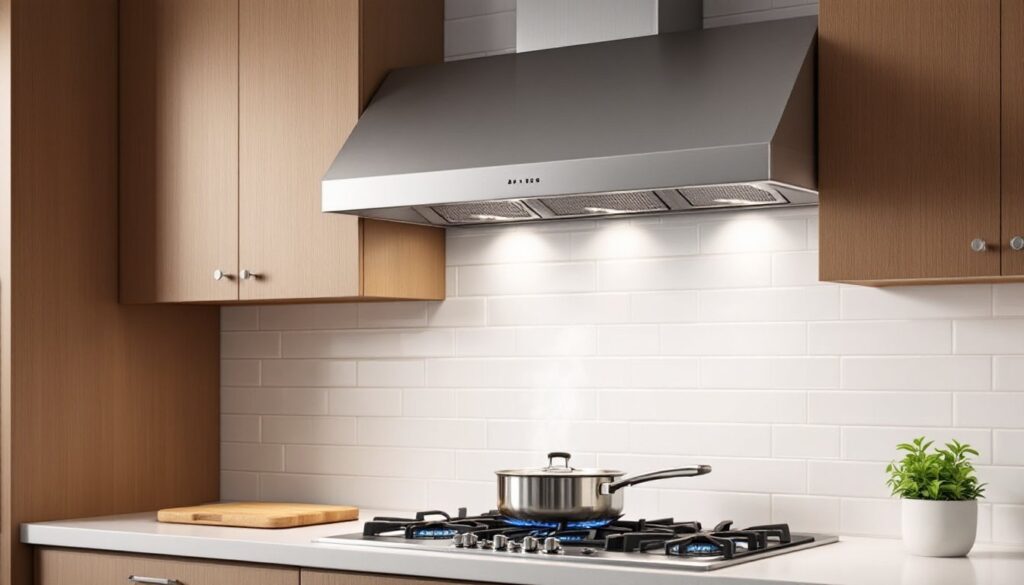
An over range hood (also called a range hood or kitchen exhaust hood) is a ventilation appliance mounted above a cooktop or range to remove smoke, steam, heat, grease particles, and cooking odors from the kitchen. It consists of a canopy or housing that contains a fan (or blower), filters, and lighting.
When the fan runs, it pulls contaminated air upward through grease filters, typically aluminum mesh or stainless steel baffles, that trap grease and larger particles. Depending on the configuration, the filtered air is either:
- Exhausted outdoors through ductwork (ducted system)
- Recirculated back into the kitchen after passing through charcoal filters (ductless system)
Ducted hoods are more effective because they completely remove moisture and combustion byproducts, while ductless models only filter odors and grease, returning the same air, and its heat and humidity, back into the space.
Most hoods include multiple fan speeds, built-in LED or halogen task lighting, and controls ranging from push-button panels to touch-sensitive interfaces or remote operation. Higher-end models may feature automatic sensors that activate the fan when heat or smoke is detected.
Over range hoods are governed by the International Residential Code (IRC) in many jurisdictions, which sets minimum ventilation rates for residential kitchens. While codes vary, the IRC generally recommends exhaust rates of at least 100 CFM (cubic feet per minute) for standard cooking appliances.
Types of Over Range Hoods: Ducted vs. Ductless
Choosing between ducted and ductless configurations is one of the most important decisions when selecting an over range hood.
Ducted (Vented) Hoods
Ducted hoods connect to external ductwork that vents air outside the home. They’re the gold standard for kitchen ventilation because they permanently remove heat, moisture, smoke, and odors. Key advantages:
- Superior performance, especially for high-heat cooking (gas ranges, woks, grilling)
- Removes combustion gases and carbon monoxide from gas appliances
- No recurring filter replacement costs beyond grease filters
- Keeps kitchen cooler and drier
The main drawback is installation complexity. Ducting requires a clear path to an exterior wall or roof, and duct runs should be as short and straight as possible, ideally under 30 linear feet with minimal elbows. Each 90-degree elbow reduces airflow efficiency by roughly 10%. Installation may require cutting through walls or ceilings and exterior penetration, which can affect siding or roofing warranties.
Ductless (Recirculating) Hoods
Ductless hoods use multi-layer charcoal or activated carbon filters to absorb odors before recirculating air back into the kitchen. They’re suitable when ducting isn’t feasible, such as in condos, apartments, or kitchens with no exterior wall access. Advantages include:
- Simpler installation with no ductwork needed
- Lower upfront cost
- Flexibility in placement
But, they come with trade-offs. Ductless hoods don’t remove heat or humidity, and charcoal filters must be replaced every 3-6 months depending on cooking frequency, adding ongoing expense. They’re less effective with heavy grease or high-BTU cooking. Think of them as a compromise when ducting simply isn’t an option.
Convertible Models
Many hoods are sold as convertible, meaning they ship configured for ducted use but include a charcoal filter kit for ductless conversion. This offers flexibility if homeowners move or remodel.
Key Features to Look for When Buying an Over Range Hood
CFM Rating and Ventilation Power
CFM (cubic feet per minute) measures how much air the hood can move. It’s the single most important performance spec. The right CFM depends on cooktop type and BTU output.
A common rule of thumb:
- Electric ranges: Minimum 100 CFM per linear foot of cooktop width (so a 30-inch range needs at least 250 CFM)
- Gas ranges: Divide total BTU output by 100. A 40,000 BTU cooktop needs about 400 CFM
- High-BTU burners or pro-style ranges: May require 600-1200 CFM or more
Undersized hoods won’t keep up with heavy cooking, leaving grease buildup and lingering odors. Oversized fans can create negative pressure in tightly sealed homes, potentially backdrafting combustion appliances, a serious safety concern. For homes with gas water heaters or furnaces, consult an HVAC professional if installing a hood over 400 CFM.
Ducted hoods lose efficiency with longer duct runs or multiple bends, so buyers should factor in their ductwork when choosing CFM. Manufacturers often provide derating charts.
Noise Levels and Sones
Ventilation power means nothing if the noise drives everyone out of the kitchen. Hood noise is measured in sones, where:
- 1 sone = roughly the sound of a quiet refrigerator
- 4 sones = normal conversation level
- 8+ sones = noticeably loud, like a vacuum cleaner
Quality hoods operate at 3-6 sones at mid-speed and 6-8 sones at full blast. Anything over 9 sones becomes disruptive during meal prep or conversation.
Noise comes from the blower motor, airflow turbulence, and ductwork vibration. Inline or external blowers, mounted in the attic or outside, dramatically reduce kitchen noise but add installation cost and complexity. Internal blowers with insulated housings and centrifugal (squirrel cage) fans tend to be quieter than axial fans.
Check sone ratings at the CFM level needed most often. A hood that’s whisper-quiet at 200 CFM but screams at 400 CFM won’t be pleasant to use.
Installation Considerations: What You Need to Know Before You Buy
Proper installation is critical for performance and safety. Several factors determine whether a hood will work in a given kitchen.
Sizing and Clearance
Hoods should be at least as wide as the cooktop, ideally 3-6 inches wider on each side to capture rising heat effectively. The IRC requires minimum clearances:
- 18 inches above electric cooktops
- 24-30 inches above gas ranges (check manufacturer specs and local codes)
Insufficient clearance creates fire hazards: too much height reduces capture efficiency. Measure carefully, especially with low ceilings.
Ductwork Requirements
For ducted installations, use rigid metal duct (galvanized steel or aluminum) rather than flexible foil duct, which restricts airflow and collects grease. Standard residential duct diameter is 6 or 7 inches for most hoods: high-CFM models may need 8-10 inches.
Keep duct runs short and straight. Terminate with a wall cap or roof vent with a damper to prevent backdrafts. Never vent into an attic, crawlspace, or soffit, moisture and grease will cause mold and damage.
Electrical and Switches
Most hoods require a dedicated 120V circuit. Hardwiring is common, though some models accept a standard plug. If replacing an over-the-range microwave, the existing outlet may work, but verify the hood’s electrical requirements.
Permits and Codes
Ventilation alterations often require permits, especially when cutting exterior penetrations or modifying ductwork. Local codes may mandate make-up air systems for hoods over 400 CFM to prevent negative pressure issues in tight homes. Check with the building department before starting work.
DIY vs. Professional Installation
Replacing an existing hood with a similar ducted model is manageable for experienced DIYers with basic tools, drill, level, screwdriver, possibly a jigsaw for cabinet modifications. First-time duct installation, roof penetrations, or range hood conversions from ductless to ducted typically warrant hiring a professional, especially if structural cutting or roofing work is involved.
Maintenance and Cleaning Tips for Long-Lasting Performance
Neglected hoods lose suction, spread grease around the kitchen, and become fire hazards. Regular maintenance is straightforward.
Grease Filter Cleaning
Aluminum mesh or baffle filters should be cleaned every 1-2 months for average use, more often for heavy cooking. Most are dishwasher-safe, run them on a hot cycle with a grease-cutting detergent. For hand washing, soak in hot water with dish soap or a degreaser like TSP (trisodium phosphate), scrub with a brush, rinse, and air dry.
Skip abrasive pads on stainless steel baffles to avoid scratching.
Charcoal Filter Replacement (Ductless Hoods)
Activated carbon filters aren’t washable. Replace them every 3-6 months depending on cooking frequency. Some models use indicator lights to signal replacement time. Reduced odor control is the first sign filters are spent.
Exterior and Interior Cleaning
Wipe down the hood exterior weekly with a damp microfiber cloth and mild cleaner. For stainless steel, use a dedicated stainless cleaner and wipe with the grain to avoid streaks. Clean the underside and interior surfaces monthly to remove grease buildup, accumulated grease is a fire risk.
Ductwork Inspection
Every few years, inspect accessible duct sections for grease accumulation. Professional duct cleaning may be needed for heavily used systems, similar to dryer vent cleaning.
Fan and Motor Care
Most modern blowers are maintenance-free, but if airflow seems weak even though clean filters, check for obstructions or damaged fan blades. Listen for unusual noises that might indicate worn bearings.
Replace burnt-out bulbs promptly, many hoods use specialized LED modules or halogen bulbs. Consult the manual for compatible replacements.
Proper maintenance preserves performance, extends the hood’s lifespan, and protects the kitchen from grease damage. An over range hood is a workhorse appliance, treat it accordingly, and it’ll keep the air clear for years.