A miter saw isn’t just another power tool cluttering up the garage, it’s the go-to machine for making precise angled cuts in wood, trim, and molding. Whether cutting crown molding at a 45-degree angle or squaring off a 2×4, the miter saw delivers clean, repeatable cuts faster than almost any other saw in the shop. It’s a staple on job sites and in home workshops for good reason: it does one thing exceptionally well. This guide breaks down what a miter saw actually is, how it’s built, how it operates, and when to reach for it over other cutting tools.
Table of Contents
ToggleKey Takeaways
- A miter saw is a stationary power tool designed to make precise angled cuts and crosscuts by bringing a rotating blade down onto stationary material held against a fence, excelling at tasks like trim, molding, and framing where repeatability matters.
- The miter index scale allows quick angle adjustments from 0 to 45 degrees (or more on some models), eliminating the need for complicated setups or jigs when cutting miters and bevels.
- Compound and sliding compound miter saws add versatility by enabling bevel cuts and increasing crosscut capacity, with dual-bevel models saving time by eliminating the need to flip workpieces.
- Miter saws outperform circular saws and table saws for crosscutting and angled cuts, offering faster setup and superior repeatability for making dozens of identical cuts on trim, framing lumber, and decking.
- Always prioritize safety with hearing protection, safety glasses, and proper hand placement, and never disable the blade guard or reach near the blade while it’s spinning at 3,000 to 5,000 RPM.
Understanding the Miter Saw: A Complete Definition
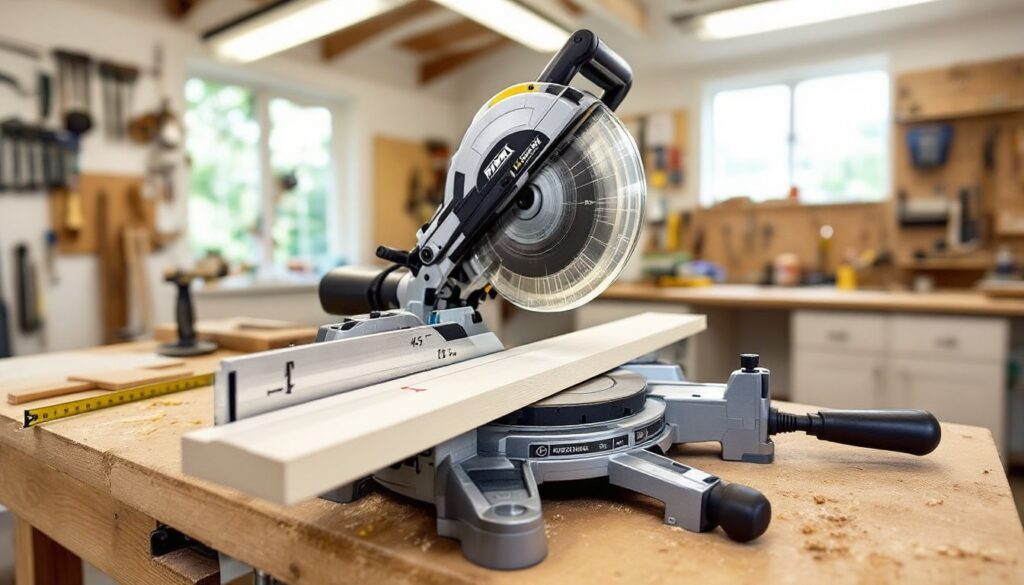
A miter saw is a stationary power saw designed to make quick, accurate crosscuts and angled cuts (miters) in a workpiece. The saw blade is mounted on a pivoting arm that swings down onto material held against a fence. Unlike a table saw where the material moves through a stationary blade, the miter saw keeps the workpiece still while the blade comes to it.
The defining feature is the miter index, a scale at the base that allows the saw head to rotate left or right, typically from 0 to 45 degrees (some models go further). This lets the user cut angles without complicated setups or jigs. The saw excels at cutting trim, framing lumber, decking, and any material requiring repeatable angle cuts.
Most miter saws use a circular blade ranging from 7¼ inches to 12 inches in diameter. Blade size determines maximum cutting capacity, larger blades cut wider and thicker stock. The saw sits on a base with a rotating table, a vertical fence to register the workpiece, and a handle-mounted trigger to control the motor. The motor typically runs at 3,000 to 5,000 RPM, driving the blade through the material in a controlled downward arc.
Key Components That Make Up a Miter Saw
Understanding the parts helps users set up cuts correctly and maintain the tool over time. Here are the core components:
- Blade: Carbide-tipped circular blade, usually 10 or 12 inches. Tooth count varies, 40 to 60 teeth for finish work, 24 to 32 for framing.
- Motor: Typically 15-amp on corded models, driving the blade through direct or belt drive. Brushless motors are common on newer cordless versions.
- Miter table: The rotating base marked with degree increments. Detents (preset stops) click into common angles like 0°, 15°, 22.5°, 31.6°, and 45°.
- Fence: Vertical support, usually aluminum or composite, that keeps the workpiece square to the blade. Some fences slide to accommodate bevel cuts.
- Bevel adjustment: Allows the saw head to tilt left or right for bevel cuts. Single-bevel saws tilt one direction: dual-bevel models tilt both ways.
- Blade guard: Spring-loaded cover that retracts during the cut and returns to protect the blade at rest. Never disable or remove the guard.
- Dust port: Connects to a shop vac or dust bag to capture sawdust. Miter saws produce a lot of fine particles, use this feature and wear a dust mask.
- Laser or LED guide (optional): Projects a line on the workpiece showing the blade path. Helpful but not a substitute for proper setup and measurement.
Quality hinges on tight tolerances in the miter and bevel locks, a flat table, and a fence that stays square under pressure.
How Does a Miter Saw Work?
Operating a miter saw is straightforward, but precision comes from setup and technique.
- Set the angle. Rotate the miter table to the desired angle using the index. Most saws have a lever or knob to release the table, then lock it at the chosen detent.
- Position the workpiece. Place the material flat on the table, tight against the fence. Mark the cut line and align it with the blade path (or laser guide if equipped).
- Secure if needed. Use the hold-down clamp for smaller pieces or anything that might shift during the cut. Never hold small offcuts by hand near the blade.
- Start the saw. Squeeze the trigger and let the blade reach full speed before cutting. Rushing into the cut can cause kickback or tear-out.
- Make the cut. Pull the handle down in a smooth, controlled motion. On sliding saws, push the blade away from you through the material, then pull it back and down.
- Release and wait. Let the blade stop completely before raising the arm. The guard should cover the blade automatically.
Safety note: Always wear safety glasses and hearing protection. Miter saws are loud, often exceeding 100 dB. Keep hands at least six inches from the blade path, and never reach under or around the guard while the blade is spinning.
Main Types of Miter Saws Explained
Miter saws come in several configurations, each adding capability and complexity.
Standard Miter Saw vs. Compound vs. Sliding Compound
Standard miter saw: Cuts miters (horizontal angles) only. The blade stays vertical. Simple, affordable, and adequate for basic trim work and framing. Limited to flat miters, no bevels.
Compound miter saw: Adds a bevel adjustment, letting the blade tilt left (single-bevel) or both directions (dual-bevel). This allows compound cuts, mitering and beveling simultaneously, essential for crown molding installed at an angle. Dual-bevel models save time by eliminating the need to flip workpieces.
Sliding compound miter saw: Incorporates rails that let the saw head slide forward and back, increasing crosscut capacity significantly. A 10-inch sliding saw can cut a 2×12 in one pass, whereas a non-sliding model maxes out around a 2×6. The trade-off: sliding saws cost more, weigh more, and require deeper bench space.
Cordless models (18V to 60V platforms) offer portability for job sites without power. Runtime and cut capacity are less than corded versions, but battery technology has closed the gap for most finish carpentry.
For homeowners tackling trim, a 10-inch dual-bevel sliding compound saw hits the sweet spot between versatility and cost. Framers often prefer 12-inch models for wider stock.
Common Uses and Applications for Miter Saws
Miter saws shine in applications requiring repeated, accurate angled cuts:
- Trim and molding: Baseboards, door and window casings, crown molding. Miters let joints meet cleanly at corners without visible fasteners.
- Framing: Cutting studs, rafters, and headers to length. The saw’s speed and repeatability beat a circular saw when cutting dozens of identical pieces.
- Decking and fencing: Crosscutting deck boards, fence pickets, and rails. A stop block clamped to the fence ensures uniform lengths.
- Picture frames: Small, precise miters at 45 degrees. A fine-tooth blade (60+ teeth) minimizes tear-out on hardwoods.
- Furniture projects: Cutting legs, stretchers, and aprons to length with clean, square ends. Compound angles for tapered legs or angled joinery.
The miter saw is not ideal for ripping lumber (cutting along the grain) or cutting sheet goods like plywood. Use a table saw or circular saw with a guide for those tasks.
Pro tip: When cutting trim in place (coped inside corners), the miter saw cuts the initial 45-degree miter: the coping saw finishes the profile. It’s a team effort, not a solo act.
Miter Saw vs. Other Saws: What Makes It Different?
Knowing when to reach for a miter saw versus another tool saves time and improves results.
Miter saw vs. circular saw: A circular saw is portable and versatile, handling rips, crosscuts, and even plunge cuts. But it requires a guide or jig for accurate angles and can’t match a miter saw’s speed or repeatability for crosscuts. For trim or framing where you’re making the same cut over and over, the miter saw wins. For breaking down sheet goods or cutting in tight spaces, grab the circular saw.
Miter saw vs. table saw: A table saw excels at ripping long boards and cutting sheet goods with a fence. It can crosscut with a miter gauge or sled, but setup is slower and less intuitive than a miter saw. Table saws are stationary and require more shop space. If the project is mostly crosscuts and miters, the miter saw is faster and safer.
Miter saw vs. radial arm saw: Radial arm saws were once the crosscut king but have fallen out of favor due to safety concerns and alignment drift. Miter saws are more compact, easier to adjust, and less prone to kickback. Few manufacturers still make radial arm saws.
Miter saw vs. chop saw: Chop saws (abrasive saws) use an abrasive disc to cut metal, masonry, or concrete. They look similar but serve entirely different purposes. Don’t confuse the two, using an abrasive disc on wood is dangerous, and a wood blade on metal will destroy the blade and create sparks.
In most home shops, a miter saw and a table saw cover 90% of cutting tasks. Add a circular saw for portability, and the toolkit is complete.